Applications are being accepted for the Taubman Institute Emerging Scholars Program.
The applicant must be a junior member of the faculty at the University of Michigan; generally, that means holding an assistant professor title. The applicant must have either an M.D. or an M.D./Ph.D. It is required that candidates both conduct basic research and treat patients.
Applicants should submit a two-to-three page research proposal, as well as a current CV. Priority will be given to proposals involving translational research. Please submit material to This e-mail address is being protected from spambots. You need JavaScript enabled to view it. . The deadline is May 7, 2012.
About 125 supporters of cutting-edge medical research mixed socializing and science May 9 at a cocktail party in Manhattan hosted by the Young Friends of the Taubman Institute's New York City chapter.
The event introduced Dr. Parag Patil, a University of Michigan physician-researcher and a prospective Young Friends Emerging Scholar. Here's a clip from Dr. Patil's appearance on the TV program "The Doctors," where he demonstrates how deep-brain stimulation has helped a patient with Parkinson's disease.
Emerging Scholars are early-career clinician-scientists who show great promise in research aimed at new cures or treatments; through the Taubman Institute, donors support them with three-year grants while their labs earn the credentials to win broader funding support.
The Young Friends event, which raised a significant contribution toward the Emerging Scholars program, was held at the ABC Carpet & Home showrooms at 888 Broadway, Attendees enjoyed cocktails, appetizers, a silent auction and a presentation by Dr. Patil. The silent auction included jewelry, fashion items, a Botox consultation and treatment, Morgan Hotel Group rooms and the opportunity to bid on a meeting and photo with former President William Jefferson Clinton.
Avastin and Sutent have been found to increase the growth of breast cancer stem cells in mice, according to Taubman Scholar Dr. Max Wicha, director of the U-M Comprehensive Cancer Center.

Taubman Scholar Dr. Charles Burant tests promising diabetes drugTAK-875, a new treatment for type 2 diabetes, improves blood sugar control and is equally effective as glimepiride, but has a significantly lower risk of creating a dangerous drop in blood sugar, called hypoglycemia, according to a new study. |
Taubman Institute leaders make the case for more doctor-scientist funding
The prestigious "Academic Medicine" journal has just published a new article authored by Taubman Institute senior management and Detroit-area attorney Scott Roberts. The article explores the problematic gap between bench research and clinical application of new treatments or cures. |
Help Us Make A Difference. Make A Gift.
Leaders from the realms of business, academia and the community help to refine the Taubman Institute's vision, to monitor progress and to provide support, advice and counsel.
Meet the Leadership Advisory Board
Meet the Scientific Advisory Board

|
Program for Neurology Research & Discovery Consortium for Stem Cell Therapies |
|
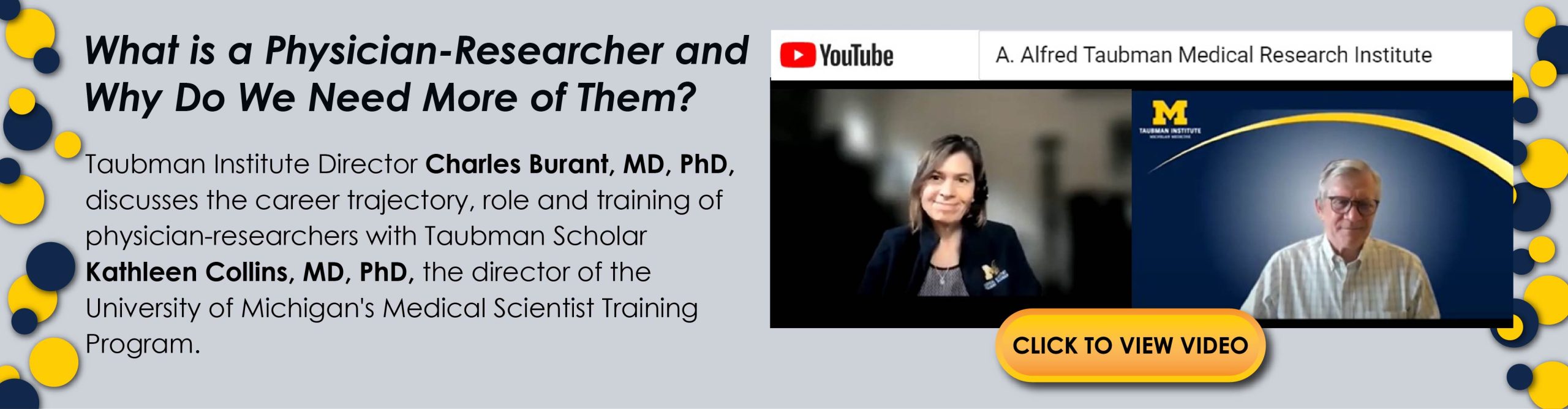
In this video feature, Taubman Scholars explain why funding for high-risk research is so important to their work and to the discovery of promising cures and treatments.